Six gates from dock to dispatch
A defect has a cost curve. A wrong reel caught at incoming costs a return; the same part found after reflow costs a rework and a scrapped board; found in the field it costs a recall. Quality control is the discipline of placing gates where that curve is still flat.
Gate 1 — incoming (IQC)
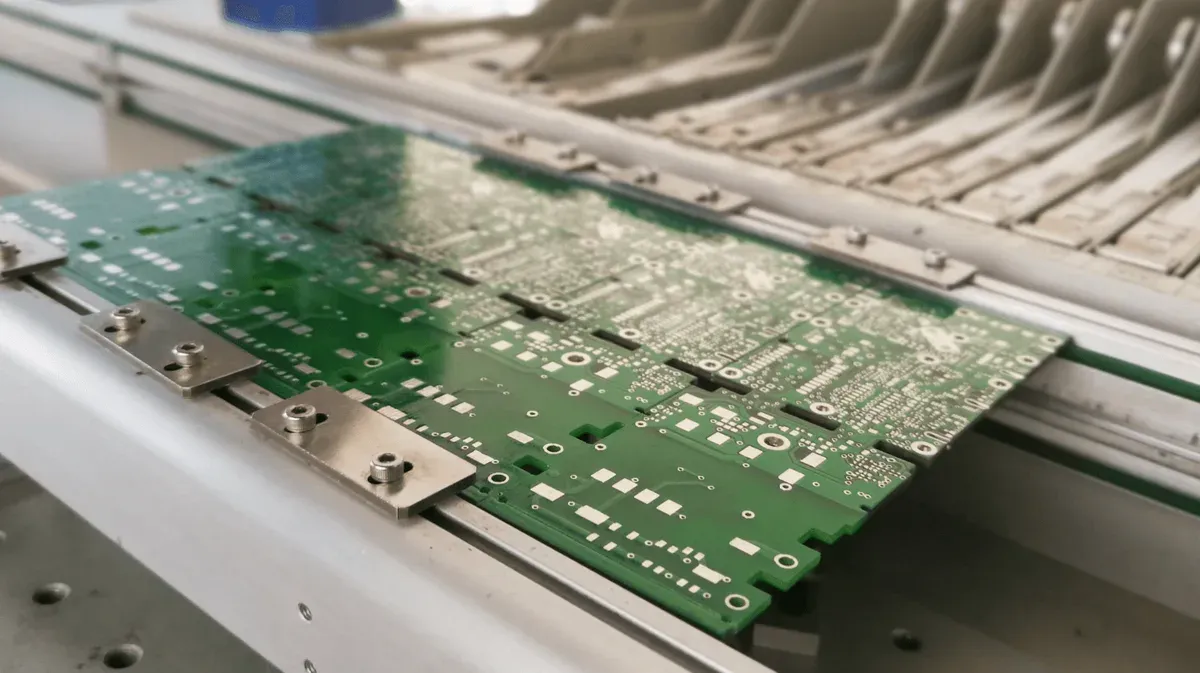
Components, bare boards and consumables are checked before they enter the line: markings against the BOM, packaging integrity, moisture-sensitivity level, and the board's finish and registration. Where the supply chain is long, this is also where counterfeit checks belong.
Gate 2 — paste printing
SPI after printing measures height, area and alignment. Under-stencil cleaning, paste viscosity and room conditions are monitored here because they drift within a shift; a print that is 20 % thin on a fine-pitch pad becomes an open joint after reflow.
Gate 3 — first article
Before the run continues, the first assembled board is checked against the documentation: correct parts and polarity, placement offset, paste volume, solder joints and test results. This gate is described in more detail in the FAI note.
Gate 4 — in-process (IPQC)
While the line runs, the process is monitored rather than the product alone: placement accuracy, oven profile against the paste specification, feeder state and AOI results trended per station. A machine repeats its mistake, so an error found here is worth a hundred found at the end.
Gate 5 — electrical and functional test
ICT or flying probe checks opens, shorts and component values; functional test runs the product. Where the application justifies it, burn-in and thermal cycling run the assembly through temperature before it ships. Coverage is a design question — test points are placed in DFT review, not after layout.
Gate 6 — final and outgoing
Visual inspection against IPC-A-610, labelling, packing and the documentation package. The lot record ties the gates together: incoming data, SPI and AOI results, X-ray images, test logs and any repair. Without that record, a later complaint cannot be traced to a station.
What the customer receives
For an automotive build under IATF 16949:2016 the record is part of the contract; for everyone else it is what makes a field failure diagnosable. The certifications behind the system are on the certificates page, the process limits on the PCBA manufacturing page, and the test gates in the inspection note.