Two polymers, not two grades
The names are close enough to be confused, but polyamide and polyimide are different materials. Polyamide is the nylon family; polyimide (PI) is the imide polymer behind Kapton and the other flexible circuit films. The distinction matters because a specification that says "polyamide" describes a material no fabricator stocks for flex.
FR-4 is a different construction again: woven glass cloth impregnated with epoxy, laminated under heat and pressure. It is stiff because the glass is stiff, and that is the property that decides where it can and cannot be used.
What polyimide buys
- Bending. A 12.5–50 µm film with 0.5–2 oz copper folds, and the same circuit on FR-4 does not.
- Temperature. Polyimide retains its mechanical properties well above the range where epoxy laminates soften, which is why it appears in engine-bay, medical and industrial assemblies.
- Chemical resistance. Solvents and fluxes that attack epoxy leave polyimide largely unaffected.
- Thickness. A flex core is thinner than any rigid laminate, which is what allows a circuit to disappear into a housing.
What it costs
Flexibility is not free. Polyimide absorbs more moisture, expands more in the plane and is less dimensionally stable than FR-4, so panel registration and coverlay alignment are harder. The material itself costs more, the process steps — coverlay lamination, stiffener bonding, laser or die cutting — cost more, and the panel is harder to handle.
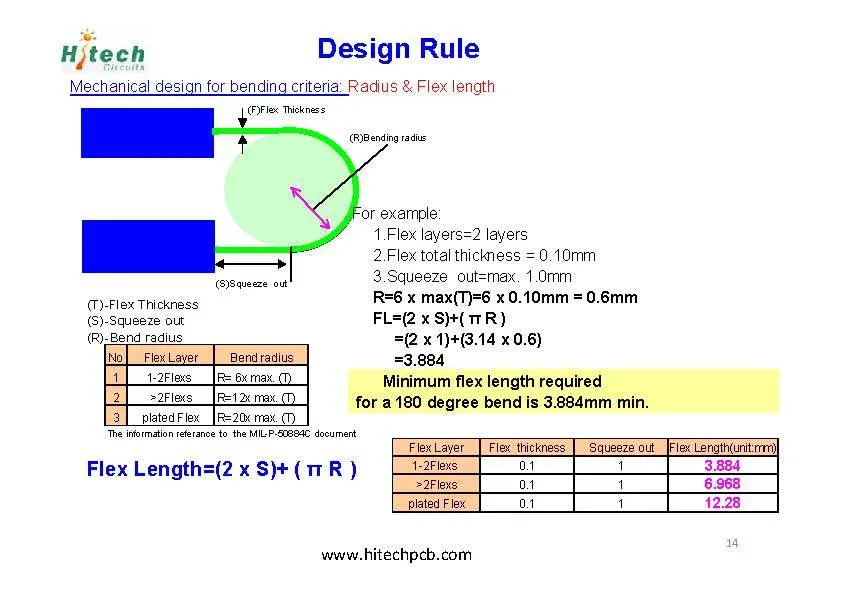
There is also a design cost: flex rules are not FR-4 rules. Conductors cross a bend at right angles, plating stays out of the flexing region, and the bend radius is agreed before layout rather than after.
Where FR-4 still wins
Most of a rigid-flex board is FR-4. The processor, the connector field and the power stage sit on rigid material because nothing there needs to move, and FR-4 is cheaper, flatter and better understood. The polyimide is used only for the section that folds.
That is the practical decision rule: put flexibility where the geometry demands it, and laminate everywhere else. The flexible PCB page covers the film-based builds, the rigid-flex page the combination, and the capability page the thickness ranges for both.