Where the money is decided
By the time a quotation is negotiated, most of the assembly cost is already fixed: by the panel, the BOM, the test strategy and the batch size. The six levers below move those inputs rather than the hourly rate.
1. Panel utilisation
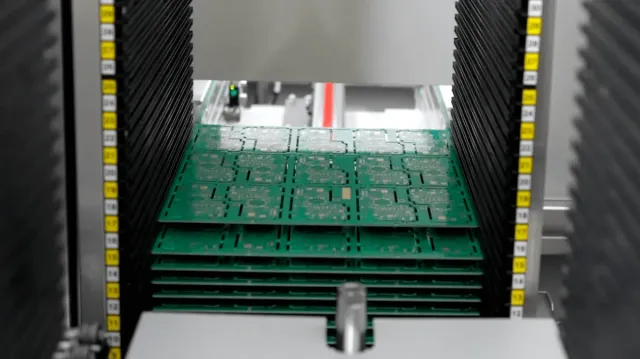
Printing, placement and reflow are per-pass costs, and a panel carries several boards per pass. More boards per panel means fewer passes per board.
Practical moves: keep the outline rectangular where the mechanical design allows, use a standard panel size that can be shared with other jobs, and let the fabricator propose the array rather than fixing it in the drawing.
2. BOM consolidation
Every unique line item is a feeder, a setup check and a purchasing action. Two resistor values that could be one, two capacitor voltages that could be the next standard up, and a connector that already exists elsewhere in the product all reduce the setup.
The limit is engineering: consolidating a value is free, changing a tolerance is not.
3. Layers and copper weight
Fewer layers with tighter routing can beat more layers with slack — or the reverse, once the routing needs microvias. On a heavy copper build, putting the weight only where the current is (rather than on every layer) is usually the largest single saving.
4. Test strategy
ICT with a fixture, flying probe, or functional test only: the choice is a cost-versus-risk decision, not a quality decision. A flying probe avoids fixture cost at low volume; a fixture becomes cheaper once the design runs often; functional test catches what neither can.
5. Order size and batching
Setup amortisation favours larger batches; inventory carrying cost favours smaller ones. The useful question is how much of the annual demand one build can cover without turning the stock into a liability — and whether the design is stable enough to commit that far ahead.
6. Lead time
Rush builds pay for re-sequenced lines, express freight and overtime. A schedule that allows the standard 4–10 days for medium volume, rather than a 48-hour promise, removes a premium that buys nothing but speed.
What not to trade away
Some savings cost more than they return:
- Paste and profile shortcuts. A cheaper paste or a faster profile shows up as voids, tombstoning and field returns.
- Skipping first article. The setup error is then repeated across the whole batch.
- Unapproved substitutes. A part that is electrically similar but mechanically different can fail assembly or thermal cycling.
- No cleaning before coating. Coating traps the residue and turns a cosmetic issue into leakage.
A practical order of work
- Fix the array and the panel.
- Consolidate the BOM with the design team.
- Choose copper weight and layer count against the routing, not by habit.
- Set the test strategy from the cost of a field failure.
- Then choose the batch size and the lead time.
A BOM quotation comes back within 24 hours of a complete data package, and prototypes run in 1–3 days, which is enough to test the levers before committing to volume. The process limits are on the PCBA manufacturing page; board-level cost drivers are in the rigid board note.